
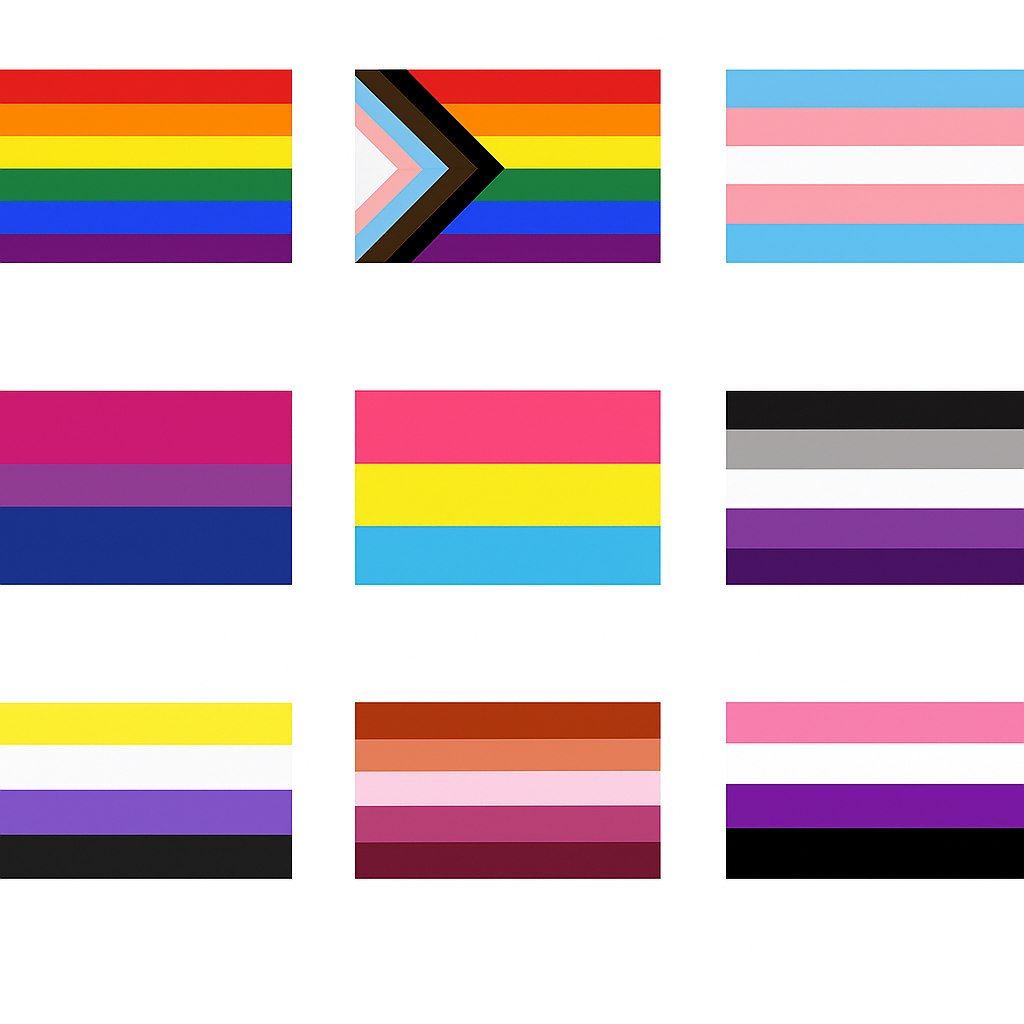
9 Queer Flags You Should Know 🏳️🌈
Share
9 Queer Pride Flags and the Real Stories Behind Them
Queer people have always found a way to say "we're here" — coded handkerchiefs, secret signals, and eventually, entire city blocks draped in color. Flags turned out to be one of the loudest ways to do it. Here are nine pride flags and their meanings, because "it's just a rainbow" is doing some serious historical erasure.
1. Rainbow Pride Flag Meaning and History
1978. Artist Gilbert Baker hand-stitches the first Pride flag at Harvey Milk's request, and it flies in San Francisco's Gay Freedom Day Parade. The original had eight stripes: hot pink (sex), red (life), orange (healing), yellow (sunlight), green (nature), turquoise (magic), indigo (serenity), violet (spirit). Fabric shortages — and capitalism doing what capitalism does — cut it down to the six-stripe version we know today. Before rainbow merch hit every big-box store in America, this flag was a genuinely radical act at a time when being visibly out could get you killed.
2. Progress Pride Flag Meaning
2018: designer Daniel Quasar looks at the classic rainbow and asks, who's missing from this picture? The answer becomes a triangle of black and brown stripes for queer people of color, plus pink, blue, and white pulled from the trans flag. The triangle points forward on purpose — it's not decoration, it's a statement that the work isn't finished. You'll see this version on government buildings and emoji keyboards now, which is either progress or a lot to process, depending on the day.
3. Transgender Pride Flag Meaning
Designed in 1999 by Monica Helms, a trans activist and Navy veteran. Blue for boys, pink for girls, white for everyone transitioning or existing outside the binary entirely. Helms made it symmetrical on purpose — flip it any direction and it's still correct, which feels like the whole point. The original flag lives in the Smithsonian now. Official queer heritage, no notes.
4. Bisexual Pride Flag Meaning
Michael Page designed this one in 1998 specifically to fight bi erasure — the whole "you're just half gay" nonsense. Pink for attraction to the same gender, blue for attraction to different genders, and purple where they overlap, representing attraction that isn't bound by binaries. Page pulled from an earlier symbol called the "biangles," two overlapping triangles from '90s bi community spaces, and gave it a design that finally stuck.
5. Pansexual Pride Flag Meaning
This one's a Tumblr baby. It surfaced online around 2010, created by a nonbinary person known as Jasper V., specifically so pan folks would stop getting folded into "basically bisexual." Pink for attraction to women, blue for attraction to men, yellow for attraction to nonbinary and gender-diverse people. It's one of the most recognizable flags to come out of internet-era queer culture — spread through memes and fan art faster than most brands manage in a full marketing cycle.
6. Asexual Pride Flag Meaning
In 2010, the community at the Asexual Visibility and Education Network (AVEN) voted this one into existence — no single designer, just collective agreement, which feels very fitting. Black for asexuality, gray for gray-asexuality and demisexuality, white for allies, purple for community. Asexuality isn't an absence of something. It's its own full identity, thanks.
7. Nonbinary Pride Flag Meaning
Kye Rowan was 17 in 2014 when they designed this flag, because the existing genderqueer flag wasn't cutting it for everyone. Yellow for outside the binary, white for many genders, purple for a blend of male and female, black for no gender at all. It wasn't meant to replace the genderqueer flag — the two are meant to fly side by side. Also: a teenager made this. The next generation has always known exactly what it's doing.
8. Lesbian Pride Flag Meaning
The lesbian flag has had more iterations than most people's Myspace pages. Early attempts (RIP "lipstick lesbian" flag, you tried) didn't represent the full community. By 2018, the orange-to-pink gradient took over — built by the community, for the community. Each stripe carries meaning: gender nonconformity, independence, community, love, serenity, femininity. A flag by lesbians, for lesbians, in sunset colors. Correct choice.
9. Genderfluid Pride Flag Meaning
JJ Poole designed this one in 2012 to represent gender as something that shifts rather than stays fixed. Pink for femininity, blue for masculinity, white for neutrality, black for the absence of gender, purple for all genders at once. Not confusion — just a full, fluid range being represented honestly.
Every Flag Has a Pulse
These all started as statements and turned into something bigger — symbols people carry into Pride marches, tape to bedroom walls, and set as profile pictures during rough weeks. They're not just fabric. They're thread-by-thread proof that someone, somewhere, decided to be seen — so the rest of us could be too. Want to wear one? Queerky's pride flag stickers and pride tees cover most of the flags on this list.